
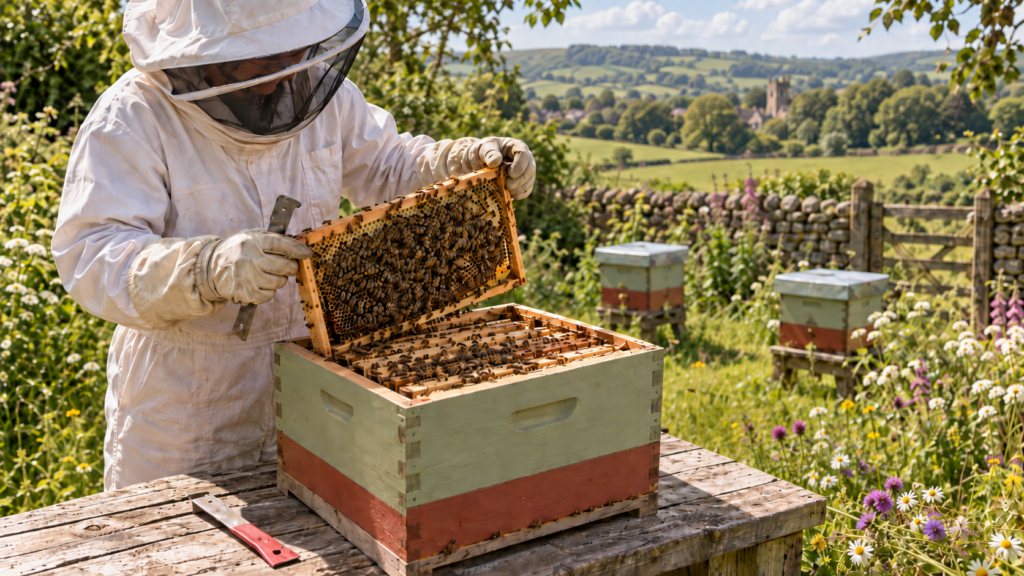
Buying your first bees is exciting, but it can also be confusing. You are not buying a machine with a fixed specification. You are buying a living colony, and naturally that raises questions. How many bees will there be? Is the queen included? Will there already be brood? What happens when you take them home?
When we talk about supplying a nuc at Barbu’s Apiary, we mean a small, functioning colony that has already begun working as one unit. Our aim is to give you a strong starting point, not simply a box containing bees.
Here is what that means in practical terms.
A mated, laying queen
At the centre of the nuc is the queen.
She is one of the first things we look for when checking the colony because the future growth of the nuc depends on her laying eggs. A mated queen should already be accepted by the workers and producing brood.
When you receive a nuc, you are not normally expected to introduce a separate queen yourself. The colony has already formed around her.
That is a major advantage for a new beekeeper. Queen introduction can be successful, but it adds another stage and another uncertainty. Starting with a queen that is already part of the colony means you can focus on learning how to inspect and manage the bees.
Brood at different stages
A healthy nuc should contain developing brood.
When you inspect a frame, you may see eggs, tiny larvae, larger larvae and capped cells where pupae are developing. Together, these different stages show that the colony is producing the next generations of worker bees.
That brood is what allows a nuc to expand.
Adult worker bees do not live forever. The colony needs a constant flow of new bees emerging to replace older workers and increase its population. A nuc with active brood has the potential to become much larger once it is transferred into a full hive.
Worker bees
Of course, the frames also come with worker bees.
These are the bees doing nearly every job you will see in and around the hive. Some care for brood, some clean cells, some process nectar, some build comb, some guard the entrance and others fly out to collect nectar, pollen, water and propolis.
The number of bees in a colony naturally changes, so it is not useful to promise an exact bee count. What matters is that there are enough workers to cover and care for the brood and support the colony.
On a warm day, many foragers may be out of the box when you inspect. On a cooler day, more may be inside. Bees are never a static product.
Food stores
A nuc also needs food.
Inside the colony you should normally find stores of pollen and honey or nectar. Pollen provides protein, especially important when the bees are raising brood. Honey and nectar provide carbohydrates and energy.
The balance of stores can vary depending on the time of year and what is flowering locally.
Beekeepers still need to monitor food after taking a nuc home. Moving a colony changes its surroundings. The bees need to learn their new location and discover local forage. Poor weather can also keep them inside for several days.
That is why learning to assess food stores is such an important early skill.
A nucleus hive for transport
The colony is housed in a suitable nucleus hive so that it can be transported safely.
A nuc box is smaller than a full-sized hive because it is designed around a smaller number of frames. It gives the bees a manageable space while the colony is developing.
Once you have the colony at its permanent location, you will normally transfer the frames into your full hive.
Before collection, it is important to make sure your equipment is ready. The last thing you want is to arrive home with thousands of bees and then realise the hive stand still needs building.
Frames that form the heart of the colony
The frames are not just pieces of equipment. They contain the colony itself.
Brood, stores and bees are organised across those frames. During transfer, the frames are moved carefully from the nuc into the new hive, maintaining their order as much as practical.
This gives the bees continuity. They are suddenly in a larger home, but their brood nest and stores move with them.
From there, the colony can begin expanding onto the extra frames you provide.
An inspected colony
Before a nuc is supplied, we want to know that the colony is developing properly.
Inspection is a normal part of responsible beekeeping. We look at the brood, the queen’s activity, the number of bees, the food available and the overall condition of the colony.
No living animal can come with a guarantee that nothing will ever change after it leaves our care. Bees can supersede a queen, swarm, experience poor weather or encounter pests and disease. But we can make sure we are happy with the colony at the point it is supplied.
If we do not think a nuc is ready, we would rather wait than rush it.
What you do not receive: a finished beekeeping experience
This is important.
A nuc gives you a strong start, but it does not remove the need to learn beekeeping.
You still need to know how to open a hive calmly, use a smoker appropriately, recognise brood, find signs that the queen is present, monitor stores, understand swarm preparation and identify common health problems.
The bees will continue changing from the moment you take them home.
That is not a disadvantage. It is the entire point.
Beekeeping is about developing the confidence to read what is happening inside the hive and respond properly.
What you should have ready before collection
Before your nuc comes home, your full hive should be assembled and positioned.
You should also have protective clothing, a smoker, a hive tool and enough compatible frames for the colony to expand onto.
Choose your hive location carefully. Bees need a suitable flight path and you need safe access for inspections. Think about neighbours, footpaths, pets and other people using the space.
A hive is much easier to position properly before it contains bees.
What happens on collection day?
Collection arrangements can vary depending on the weather and the colony, so we will explain the practical details when your nuc is ready.
The important thing is safe transport. The bees need adequate ventilation, the box needs to remain secure and the nuc should be transported in a way that prevents it from moving around.
Once home, follow the agreed guidance for positioning the nuc or transferring the frames.
Do not make the day more complicated than it needs to be. Have everything ready beforehand, work calmly and give yourself time.
Why availability can change
One of the strange things about selling bees is that you cannot manufacture more colonies because a particular weekend happens to be convenient.
The bees develop according to the season.
Queen mating depends partly on suitable weather. Brood development takes time. Colonies need enough strength before they can be split or supplied. A run of poor weather can slow everything down.
That is why nuc availability may be seasonal and why waiting lists are useful. They allow us to keep interested beekeepers informed without pretending nature works to a delivery schedule.
We want the bees to have the best possible start
We know how exciting it is to collect your first colony.
We also know the temptation to want it immediately.
But a few extra days or weeks can make a real difference if a colony needs more time. We would always rather supply bees when we are satisfied with their condition than force the process for the sake of a date.
Beekeeping teaches patience very quickly.
More than a box of bees
When you receive a nuc from Barbu’s Apiary, you are getting a small colony with all the essential parts already working together: a mated queen, developing brood, worker bees and food stores.
But you are also taking responsibility for what happens next.
You will watch those frames fill with more bees. You will see the colony expand into its full hive. You will begin recognising patterns that once looked like complete chaos.
That journey from a small nuc to a thriving colony is one of the things that makes beekeeping so addictive.
If you are interested in joining our nuc waiting list, contact Barbu’s Apiary. We can talk you through availability, what to prepare and what to expect before your bees come home.
Support starts before the bees arrive
We also want you to feel prepared before collection day. If this is your first colony, it is completely normal to have questions about equipment, positioning the hive and what happens during the first inspection. Asking those questions early is much better than trying to solve everything with a box of bees waiting beside you.
A nuc should be the start of your beekeeping journey, not a test of whether you can figure everything out alone.