There is something different about a beeswax candle.
Before you even light it, you can see and feel that it came from a natural material. The colour is warm, the wax has a subtle honey-like scent and every candle carries a connection back to the hive.
At Barbu’s Apiary, that connection matters to us.
Our beeswax candles are not separate from our beekeeping story. They begin with the wax produced by the bees, collected through the normal work of managing the hives and harvesting honey. Turning that wax into candles means we can make use of another valuable part of the colony’s work rather than treating it as waste.
Where beeswax comes from
Worker honey bees produce wax from specialised glands.
The wax begins as tiny scales, which the bees manipulate and mould into comb. They use that comb to raise brood and store honey and pollen.
Building comb takes an enormous amount of collective work.
That is why beeswax feels precious to a beekeeper.
When we handle wax, we are handling something thousands of bees helped create.
The wax left from a honey harvest
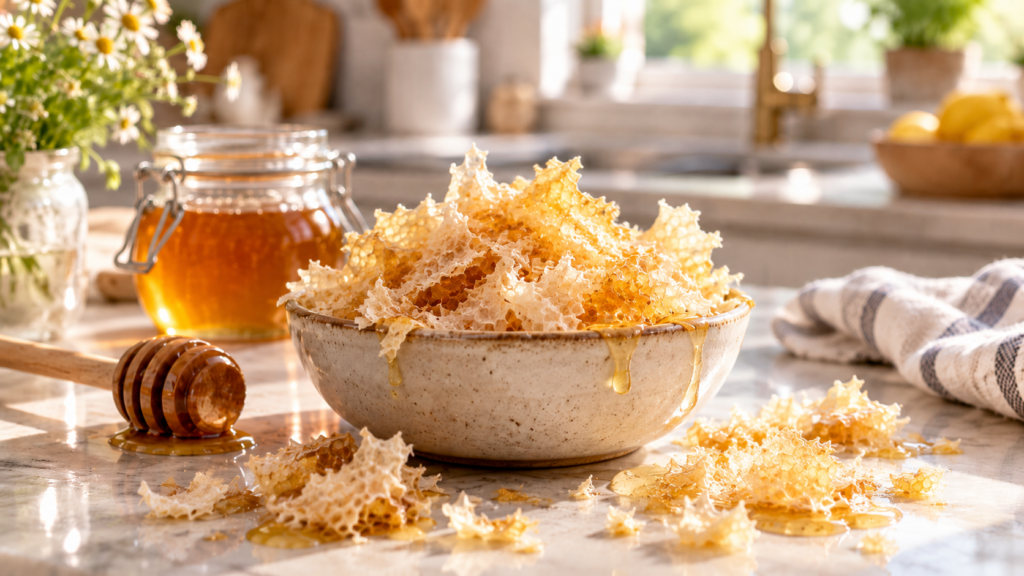
During honey extraction, we remove the thin wax cappings sealing the honey cells.
Those cappings contain very clean beeswax. After the honey is allowed to drain away, the wax can be gently cleaned and rendered.
Other pieces of suitable wax can also be collected through normal hive management.
Instead of discarding it, we can give that wax another life.
One of the loveliest uses is candle making.
Why beeswax candles are special
Beeswax has its own character.
It is firmer than many other natural waxes and has a naturally warm colour. Depending on the source and how the wax has been processed, it can range from pale cream to deep golden yellow.
It also carries a gentle natural aroma.
We do not need to force it to smell like something else. Part of the appeal is that it already smells subtly of wax, honey and the hive.
Handcrafted means there will be differences
When something is handmade from a natural material, small variations are normal.
One batch of wax may be slightly lighter than another. A candle may have tiny surface differences. The exact finish can vary depending on temperature and moulding.
We see those differences as part of the product.
The wax did not come from a factory designed to make every batch chemically identical. It came from living colonies.
That individuality is something worth keeping.
A slower kind of product
We live in a world where you can order almost anything instantly.
Beeswax does not work like that.
The bees have to produce it. Honey has to be stored and capped. Wax has to become available through the season. It then needs to be collected, cleaned, filtered and prepared before it can become a candle.
That process creates natural limits.
We cannot simply press a button and create more wax because demand increases.
And we are comfortable with that.
Why we make different shapes
Beeswax is a beautiful material for moulded candles.
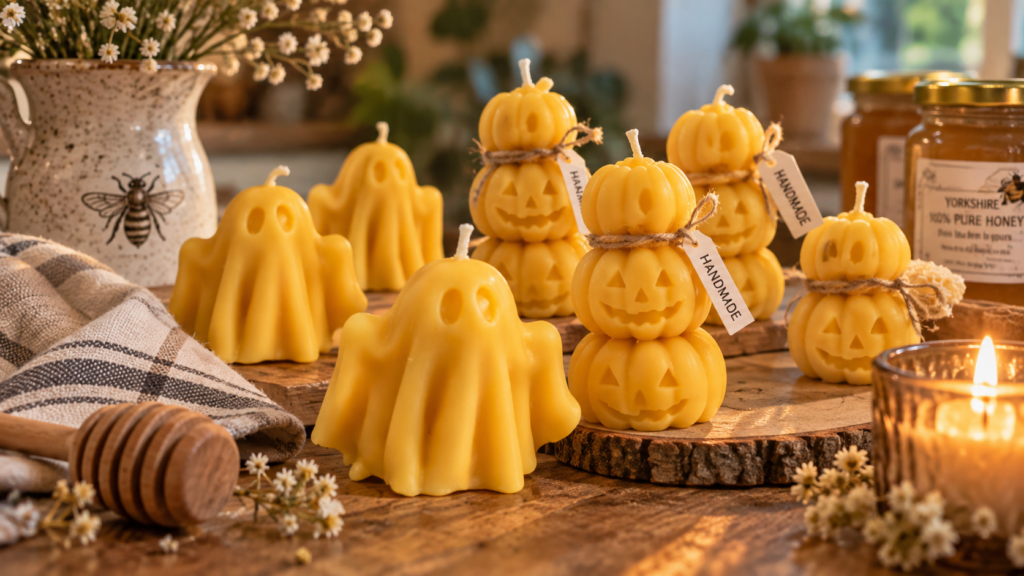
Traditional hive shapes, simple pillars, seasonal designs and decorative pieces all allow the texture and colour of the wax to become part of the finished object.
Some candles are made to be burned. Others are almost too pretty to light straight away.
We understand both approaches.
A candle can be useful and decorative at the same time.
What does a beeswax candle smell like?
People often expect a strong perfume because we are so used to scented candles.
Natural beeswax is much subtler.
The aroma can be gently sweet, warm and slightly honey-like. It is not usually a powerful artificial fragrance that fills the room before the candle is lit.
That understated quality is exactly what many people enjoy.
The scent belongs to the material itself.
How to get the best from your candle
Always place candles on a stable, heat-resistant surface and keep them away from children, pets, curtains, draughts and anything flammable.
Trim the wick if needed before lighting and never leave a burning candle unattended.
For larger candles, allow enough time for an even melt pool to begin forming rather than repeatedly burning them for only a few minutes.
Different candle shapes behave differently, so follow any care guidance supplied with the candle.
Simple candle safety makes a big difference.
Why the wick matters
The wick has to match the candle.
A wick that is too small may struggle to create a good flame. A wick that is too large may burn too strongly.
When making candles, the relationship between wax, diameter, shape and wick size all matters.
That is one reason handmade candle production involves testing rather than simply pouring wax into a mould and hoping for the best.
The final object may look simple, but getting a clean, reliable burn takes care.
Seasonal candles and gift sets
Beeswax works beautifully for seasonal designs.
Autumn shapes, festive candles, small decorative pieces and gift sets allow us to make products that feel personal without losing the connection to the hive.
We particularly like combining candles with our other products.
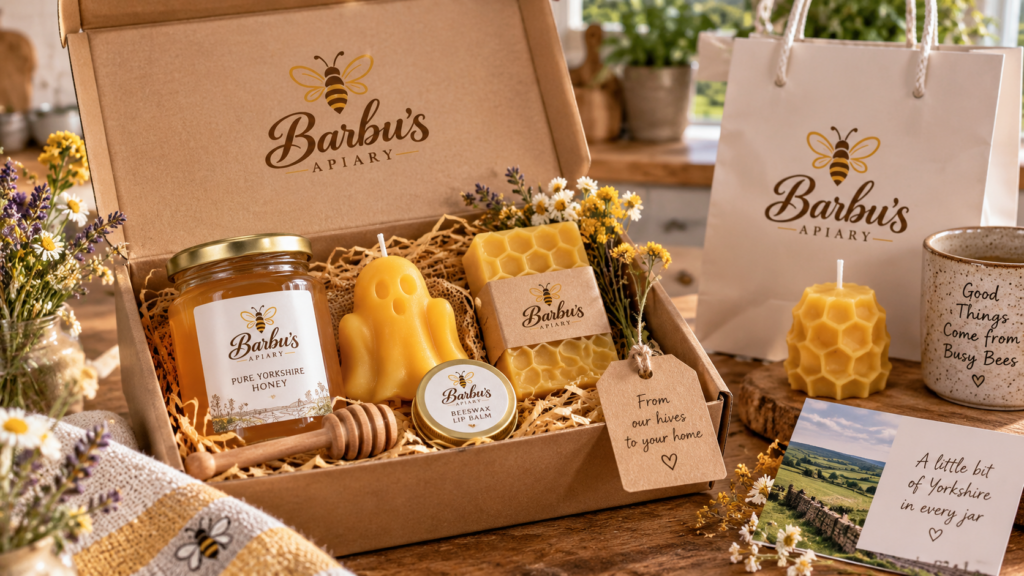
A jar of local honey and a handmade beeswax candle belong together naturally because they are different results of the same beekeeping year.
For gifts, that story matters.
A useful way to reduce waste
Beekeeping produces materials that can often be reused.
Wax is one of the best examples.
Old or unsuitable comb may need to be removed from circulation in the hive, while clean cappings wax from honey extraction can be particularly valuable.
By cleaning and reusing suitable wax, we can turn a by-product of hive management into something practical and beautiful.
That does not make beekeeping a waste-free activity, but it encourages us to think carefully about what we already have before buying something new.
Every candle starts with the bees
It is easy to look at the finished candle and forget how far back the process begins.
Before there was a candle, there was a colony.
Before there was a block of wax, worker bees were building comb.
Before we could pour a candle, frames had to be managed, honey had to be harvested and wax had to be collected.
That history is contained in the finished product even if you cannot see it.
Why we enjoy making them
Honey will probably always be the product people associate most strongly with beekeeping.
But wax tells another part of the story.
Candles allow us to share that story in a completely different way.
You can place one in your home, give one as a gift or light it on a quiet evening and know that the material began inside a working hive.
There is something comforting about that.
Small batches, made with care
At Barbu’s Apiary, we prefer small batches over mass production.
That suits beeswax naturally because the amount available changes with the season.
It also means we can enjoy making different designs and gift combinations without needing every product to be identical all year.
Some shapes may only appear for a limited period. Others may return when we have enough wax.
That makes each batch feel a little more special.
From our hives to your home
Our candles are another way of making the most of what the bees create.
They are warm, natural and closely connected to the rest of our beekeeping.
No complicated story is needed.
The bees make the wax. We collect and prepare it carefully. Then we turn it into something that can bring a little piece of the apiary into your home.
If you would like to see which beeswax candles are currently available, contact Barbu’s Apiary. We can also let you know about seasonal designs and gift sets as new batches are made.
Why beeswax feels different from mass-produced wax
Pick up a beeswax candle and it often feels more substantial than you expect. The wax is firm, the surface has a natural warmth and the colour can have depth that synthetic-looking waxes do not always have.
That physical quality is part of the appeal. You are holding a material that was first made inside a hive, not something created solely for candle production.
It also means we do not want to disguise it under unnecessary finishes. If the beeswax is beautiful, let it look like beeswax.
Candles as part of the beekeeping cycle
For us, making candles closes a small loop.
The bees build comb. We manage the colonies and harvest surplus honey when appropriate. Wax becomes available through uncapping and normal hive work. We clean it, prepare it and give it another use.
The candle then leaves the apiary and becomes part of somebody’s home.
That feels much more meaningful than treating wax as a leftover material.
A gift that has a real origin
A beeswax candle also works particularly well as a gift because you can explain where it came from in one sentence: the wax was made by bees.
That simple fact gives the object more character.
Pair it with a jar of honey and you have two completely different products created by the same colony. One can be eaten. One can be lit. Both carry the story of the hive.