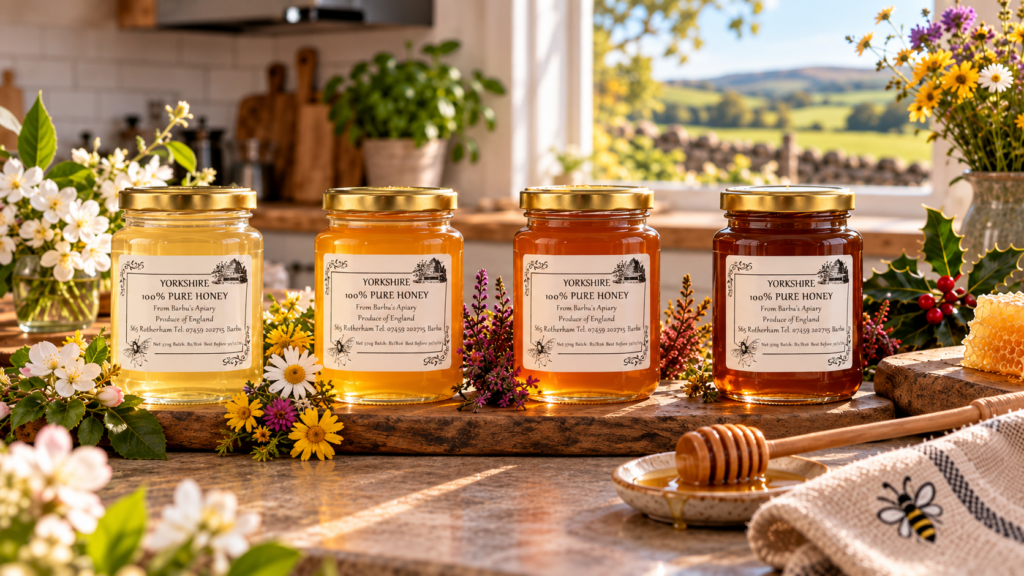
If you expect every jar of honey to look and taste exactly like the last one, small-scale beekeeping can be a surprise.
One batch may be pale gold and delicate. Another may be darker, richer or quicker to crystallise. Even jars produced from the same apiary can change through the year.
We do not see that as inconsistency.
We see it as one of the clearest signs that the honey is connected to the flowers, weather and landscape around our hives.
Bees do not follow a recipe
A food factory can repeat a recipe.
Bees cannot.
They leave the hive and visit whatever flowers are producing nectar within flying distance. As the seasons change, those flowers change too.
Spring blossom gives way to different plants in early summer. Later flowers appear as others finish. Weather determines what opens, what produces nectar and how often bees are able to fly.
The honey stored by the colony is shaped by all of that.
So when you taste a jar, you are tasting the result of thousands of individual foraging journeys.
Colour can change dramatically
Honey is not naturally one fixed shade of amber.
It can range from very pale straw colours through gold, amber and much darker shades.
Different nectar sources contribute different colours. The balance of plants being visited also changes from one part of the season to another.
That means a jar harvested earlier in the year may look noticeably different from one collected later.
We think that is interesting, not something to hide.
Flavour follows the forage
Colour is only the beginning.
Honey flavour can change from light and floral to richer, maltier or more intense profiles depending on the plants involved.
In mixed countryside and gardens, bees may collect from many different sources rather than one single crop.
That creates complex local honey.
You may not be able to identify every flower by taste, and neither can we always say exactly what percentage came from each plant.
What we can say is that the flavour reflects what was available to the bees at that time.
Weather changes everything
Beekeepers become slightly obsessed with weather for a reason.
A plant can be covered in flowers, but if conditions are too cold, wet or windy, the bees may not be able to work it effectively.
Some plants also produce more nectar under certain conditions than others.
A warm settled period can create a strong nectar flow. A long spell of rain can interrupt it.
That means two summers in the same location can produce very different honey.
The postcode stays the same. Nature does not.
The bees decide when the honey is ready
Inside the hive, fresh nectar contains much more water than finished honey.
The bees process it and reduce the moisture content. Once it is ready for storage, they seal the cells with wax.
As beekeepers, we look at the condition of the frames rather than simply deciding that a date on the calendar must be “harvest day”.
Good beekeeping means working with what the colony is doing.
Why texture can change
Honey can remain runny for a long time or crystallise relatively quickly.
Crystallisation is a natural process.
Different honeys behave differently depending on their natural sugar composition and storage conditions. Fine crystals can create a creamy texture, while larger crystals can feel grainier.
Seeing crystals in honey does not automatically mean something has gone wrong.
In many cases, it simply means the honey is doing what natural honey does.
Supermarket expectations
Large-scale food retail has trained us to expect perfect consistency.
The same product should look the same on Monday, Christmas Day and six months later.
To achieve that with honey, large suppliers may blend honey from different sources so the flavour, colour and texture remain more consistent.
There is nothing inherently mysterious about that. It is simply a different goal.
Our goal is not to make every jar identical.
We want to keep the connection to the individual harvest.
Small batches tell you more
When honey is bottled in smaller batches, differences are easier to notice.
A customer might come back and say, “This jar tastes different from the last one.”
Our answer is often: yes, it probably does.
That is not an apology.
The bees may have been working different forage. The weather may have changed. The honey may have been harvested at another point in the season.
Those differences are part of the product.
Local honey is a snapshot of place and time
We like the idea that a jar of honey records a moment.
It captures what was flowering around the hives, whether the weather allowed the bees to forage and how the colony was developing.
You could harvest from the same apiary the following year and get a different result.
That makes honey surprisingly personal.
It is food, but it is also a little record of the landscape.
Why we do not over-process it
Our aim is to keep the process straightforward.
Honey is removed from suitable frames, extracted and filtered enough to remove unwanted debris while keeping it recognisably the product the bees made.
We are not trying to strip away every natural characteristic in order to achieve industrial uniformity.
For us, variation is not a defect that needs correcting.
It is part of the appeal.
What if your honey crystallises?
You can eat crystallised honey exactly as it is.
Many people actually prefer the thicker texture because it spreads well on toast and is less likely to drip.
If you prefer it more liquid, gentle warming can help soften the crystals. Avoid excessive heat.
The important thing is not to panic and assume the jar has “gone off” because the texture changed.
Honey is a natural product and natural products change.
The best way to taste seasonal honey
Try it simply.
Taste a small amount on a spoon. Put it on plain yoghurt. Spread it on toast without adding lots of other strong flavours.
If you have two batches available, compare them side by side.
Look at the colour. Smell them. Notice whether one is lighter, fruitier, richer or more floral.
You do not need to become a professional honey judge.
Just pay attention.
Our bees, our landscape, our season
For Barbu’s Apiary, seasonal variation is part of what makes keeping bees worthwhile.
We have spent years around hives and still never know exactly what the next harvest will be like.
That uncertainty keeps it interesting.
We can manage colonies carefully, but we cannot control the weather or tell the bees which flowers they must visit.
And we would not want to.
Every jar has its own moment
When you buy a jar of our honey, we hope you enjoy the fact that the next jar may not be identical.
It might be lighter. Darker. Thicker. More floral. More intense.
That change tells you the honey came from a living landscape rather than a fixed recipe.
For us, that is something worth celebrating.
If you would like to try our current seasonal honey, contact Barbu’s Apiary to ask what we have available. And if you have bought from us before, do not be surprised if the next batch has a personality of its own.
Spring honey can feel completely different from summer honey
Early in the season, the bees may be working blossom, garden flowers and flowering trees. As the year moves on, completely different sources can dominate.
That means spring and summer honey from the same apiary can feel like two separate products.
One may be pale and gentle. The other may be darker and more assertive.
There is no guarantee that this pattern repeats exactly every year, but that is precisely the point. The season leaves its fingerprint on the jar.
Why we think customers should expect variation
We would rather tell people the truth than promise artificial consistency.
If your new jar looks different from the one you bought three months ago, ask us about it. We enjoy talking about the harvest and what was happening around the hives.
The conversation is part of buying from a small producer.
You are not dealing with a faceless supply chain. You can ask the people who looked after the colonies and bottled the honey.
Crystallisation is not a quality failure
This deserves repeating because it causes so much confusion.
Natural honey can crystallise. Some varieties do it quickly; others remain liquid for much longer. Temperature also affects the process.
Crystals do not automatically mean the honey is old, spoiled or poor quality.
For many people, crystallised honey is actually easier to use because it sits on toast instead of running down your wrist.
Taste the year rather than chasing sameness
We think one of the pleasures of local honey is noticing change.
Instead of asking, “Why is this jar not exactly like the last one?” try asking, “What was different when the bees made this?”
That small shift turns variation from a problem into part of the experience.
You begin tasting the year rather than just tasting sweetness.