A jar of honey looks simple.
Golden liquid. A lid. A label.
But by the time that jar reaches your kitchen, an extraordinary amount of work has already happened — most of it done by the bees.
At Barbu’s Apiary, we believe people should know where their food comes from. So rather than treating honey as a mysterious finished product, we want to show you the journey from flowers in the landscape to honey in the hive and finally into the jar.
It begins with flowers
Honey begins as nectar.
Foraging worker bees leave the hive and visit flowers that are producing nectar. Using their proboscis, they collect the sugary liquid and carry it in a special honey stomach.
One bee may visit many flowers on a single trip.
Then she returns to the colony.
That is why the area around an apiary matters so much. Gardens, hedgerows, trees, wildflowers and crops can all contribute forage at different times of year.
Back at the hive
The nectar does not instantly become honey.
Back inside the colony, the forager passes nectar to other worker bees. Enzymes begin changing its composition and the nectar is placed into wax cells.
At this stage it still contains too much water to store safely for long periods.
The bees need to reduce that moisture.
The hive becomes a processing room
Bees move air through the colony by fanning their wings.
This helps moisture evaporate from the nectar. Over time, it becomes thicker and more concentrated.
When the honey is ready for storage, the bees seal the cell with a thin layer of wax.
These sealed cells are what beekeepers call capped honey.
A frame covered in pale wax cappings is one of the most satisfying sights in beekeeping.
The honey belongs to the bees first
This is an important part of our approach.
Honey is not produced for us. The bees make it as food for the colony.
They need stores to survive periods when they cannot forage, particularly through winter and poor weather.
A beekeeper should always consider the colony’s needs before thinking about a harvest.
We only want to remove honey that is genuinely surplus to what the bees require.
Choosing frames for harvest
When honey is ready to be harvested, suitable frames are removed from the hive.
We look at whether the honey is properly ripened and sealed and consider the needs of the colony.
The frames are then taken to a clean area for extraction.
This is the stage most people never see.
The jar does not come directly out of the hive. There is careful handling between those two points.
Uncapping the honey
Before honey can leave the comb, the wax seals have to be removed.
These thin seals are called cappings.
They are carefully cut or lifted away, exposing the honey-filled cells underneath.
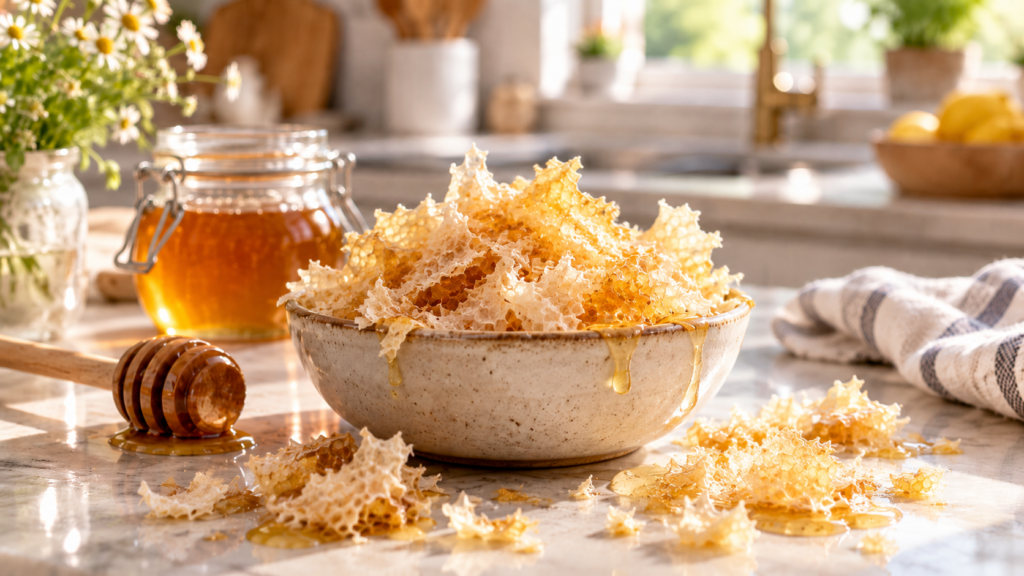
The cappings themselves are valuable. They contain honey and clean beeswax, so we do not simply throw them away.
Fresh cappings can be enjoyed as a seasonal hive product, while suitable wax can later be cleaned and used for candle making.
Extracting without destroying the frames
Once uncapped, the frames can be placed into a honey extractor.
An extractor spins the frames so that centrifugal force throws the honey out of the open cells.
The honey runs down the inside of the extractor and collects at the bottom.
One of the advantages of this process is that much of the comb structure can remain intact.
The empty frames can potentially be returned to the bees, saving them the work of rebuilding all that wax from scratch.
Filtering the honey
Freshly extracted honey can contain small pieces of wax and other harmless hive debris.
We filter it to remove those unwanted particles.
The aim is not to turn the honey into something unnaturally uniform.
It is simply to make sure the product is clean and ready for bottling while keeping the process as straightforward as possible.
We want the honey to remain recognisably connected to the hive it came from.
Letting it settle
After extraction and filtering, honey benefits from time to settle.
Air bubbles and tiny remaining wax particles can rise to the surface, making it easier to bottle cleanly.
This is another example of why honey production is not something we want to rush.
A little patience usually produces a better result.
Bottling by hand
When the honey is ready, it goes into jars.
For a small apiary, bottling is a hands-on job.
Jars need to be clean, filled carefully, closed, labelled and checked.
It may be the least glamorous stage of beekeeping, but it matters. A beautiful harvest deserves to be presented properly.
And there is always something satisfying about seeing a row of finished jars after months of work in the hives.
Why one batch may look different from another
The flowers available to the bees change through the season.
That means the honey can change too.
One batch may be pale. Another may be darker. One may stay runny for longer while another begins crystallising relatively quickly.
Flavour can also vary.
We do not blend everything together simply to make every jar taste identical.
We like those seasonal differences because they tell you something about when the honey was produced.
What “minimally filtered” means to us
Filtering honey does not have to mean heavily processing it.
Our goal is to remove unwanted pieces of wax and debris while keeping the honey as close as practical to the product that came from the hive.
We are not chasing perfect visual consistency.
If natural honey changes colour, flavour or texture, that does not worry us.
That is what natural food does.
The role of the beekeeper
A beekeeper cannot make bees produce honey.
We can keep colonies healthy, give them appropriate space, monitor them and manage the hive responsibly.
But the bees still have to do the real work.
They need suitable forage. They need flying weather. They need a functioning queen and enough workers. The season needs to cooperate.
That is why every harvest feels earned.
Years of experience, but still learning
Beekeeping has been part of our family life since our time in Romania, where our experience grew to around 250 hives.
When we later restarted in England, the environment was different and we had to learn from the local conditions all over again.
That is one of the things we love and respect about bees.
Experience matters, but the bees keep teaching you.
No two seasons are completely the same.
Nothing about honey is really instant
From the first spring flowers to a finished jar, the process takes time.
The colony has to grow. Bees have to forage. Nectar must be processed. Honey must ripen. Frames have to be inspected and selected. The harvest has to be extracted, filtered, settled and bottled.
So when you hold a jar, you are looking at the end of a very long chain of natural events.
The label is the final step, not the beginning.
From our family to yours
Barbu’s Apiary is a family business because beekeeping has always been part of our family story.
Claudiu spends time checking the colonies, looking for the queen, eggs, brood and the overall condition of the hives. Mariana plays a major role in extraction, bottling, labelling, selling and sharing the world of bees through workshops and conversations with customers.
Different jobs, same bees.
That hands-on involvement is what we want people to feel when they buy from us.
A simple product with an extraordinary journey
Honey does not need much from us to be special.
The bees have already done the difficult part.
Our job is to care for the colonies, harvest responsibly and handle the honey with respect.
Then we put it in a jar and let the flavour speak for itself.
If you would like to try honey from Barbu’s Apiary, contact us to ask about current availability. Because our honey follows the season, each batch may be slightly different — and that is exactly how we like it.
Cleaning up is part of the harvest too
The photographs of honey extraction usually show the beautiful part: frames dripping with gold.
They rarely show the sticky floor, tools, buckets, strainers and equipment that all need cleaning afterwards.
But hygiene matters at every stage. Honey is food, so the extraction area and equipment need to be handled carefully and kept clean.
A small apiary may feel personal and traditional, but that does not mean the practical standards around food handling become less important.
Labels are the last part of the story
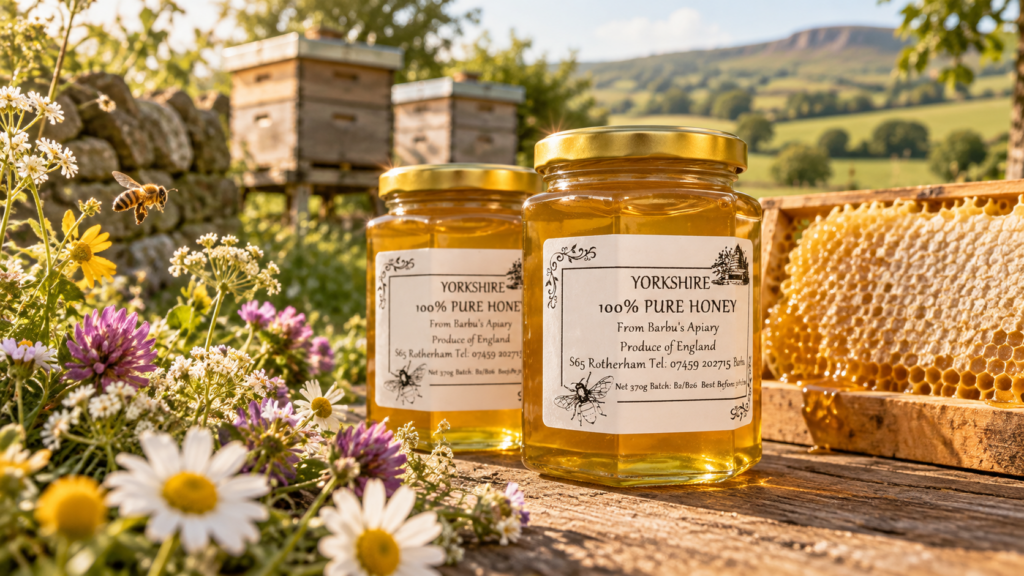
Once jars are filled, the label gives customers the information they need and identifies the product as ours.
For us, it is also a small moment of pride.
A jar that started months earlier with bees flying from flowers is finally ready to leave the apiary.
The label does not make the honey special. The bees already did that.
It simply tells you whose hives it came from.
Why we prefer to explain the process
The more people understand about honey, the more they appreciate why local batches vary and why availability changes.
There is no tap at the back of the hive.
Every jar depends on healthy colonies, suitable forage, weather and time.
Knowing that makes the finished product feel very different from something that simply appeared on a supermarket shelf.