If you have only ever seen honey in a jar, you could easily go your whole life without knowing what cappings are.
Yet for beekeepers, cappings are one of those small treasures that appear during honey extraction. They are the thin layer of beeswax the bees place over cells of ripe honey to seal it safely inside the comb.
Before we can extract the honey, those wax seals need to be removed.
And what comes off the frame is far too good to waste.
The lid the bees put on the honey
Inside a hive, bees store honey in wax cells.
As nectar is processed and its water content is reduced, it gradually becomes honey. When the bees consider it ready for storage, they cover the cell with a thin layer of wax.
That wax cover is called a capping.
Across a full frame, thousands of little cappings create a pale surface over the stored honey.
To extract the honey, a beekeeper removes that top layer and exposes the open cells underneath.
The frame can then go into an extractor, where centrifugal force spins the honey out.
Why are cappings covered in honey?
When you remove the wax seals, a small amount of honey inevitably comes with them.
That is what makes fresh cappings so enjoyable.
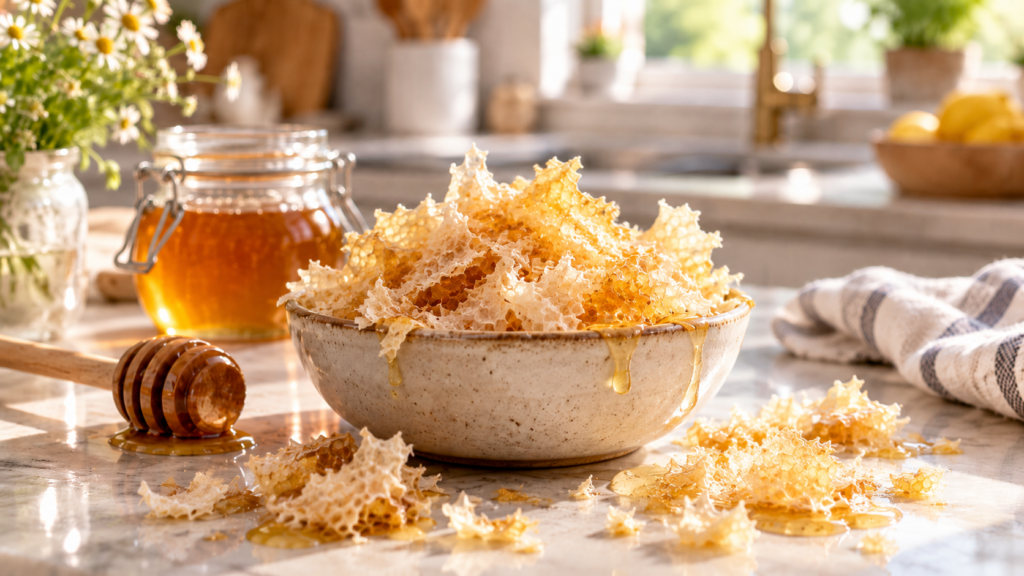
You get soft pieces of beeswax coated and filled with honey. They can be chewed much like honeycomb, releasing the honey before leaving the wax behind.
For many beekeepers, tasting fresh cappings is one of the perks of extraction day.
It is difficult to resist.
Are cappings the same as honeycomb?
They are related, but not exactly the same product.
Honeycomb is a full section of wax comb containing honey inside the cells. Cappings are the thin wax lids that were cut or lifted from the top of those cells before extraction.
Both can contain honey and both are edible, but the texture is different.
Cappings tend to be loose, irregular pieces rather than a structured block of comb.
That makes them a wonderfully rustic hive product. They do not look manufactured because they are not.
What do they taste like?
Mostly, they taste of the honey from that harvest.
Because the wax is thin and there is often plenty of honey clinging to it, the flavour can be intense and immediate.
And just as with our honey and honeycomb, the flavour can change.
If the bees have been working different flowers, the honey coating the cappings may taste different from a batch harvested earlier in the year.
That variation is one of the things we enjoy most about small-batch honey.
You never quite know what nature has made until you taste it.
How do you eat cappings?
The easiest way is simply to take a small piece and chew it.
The honey releases quickly. You can continue chewing the wax, swallow it if you wish or discard the remaining wax when the flavour has gone.
You can also serve cappings alongside cheese, yoghurt or desserts.
Because they are less uniform than cut honeycomb, they work particularly well when you want something informal and natural rather than perfectly presented.
A spoonful beside a strong cheese can be fantastic.
Can you use cappings in baking?
Yes, although the way you use them depends on what you are making.
If the cappings contain plenty of honey, small amounts can be used where you want sweetness and a little waxy texture. More commonly, people separate the remaining honey from the wax and use the two materials differently.
The honey can be eaten, while the wax can be cleaned and reused for other purposes.
For home use, though, there is no need to overcomplicate it. Fresh cappings are enjoyable exactly as they are.
What happens to the wax afterwards?
Beeswax is a valuable material.
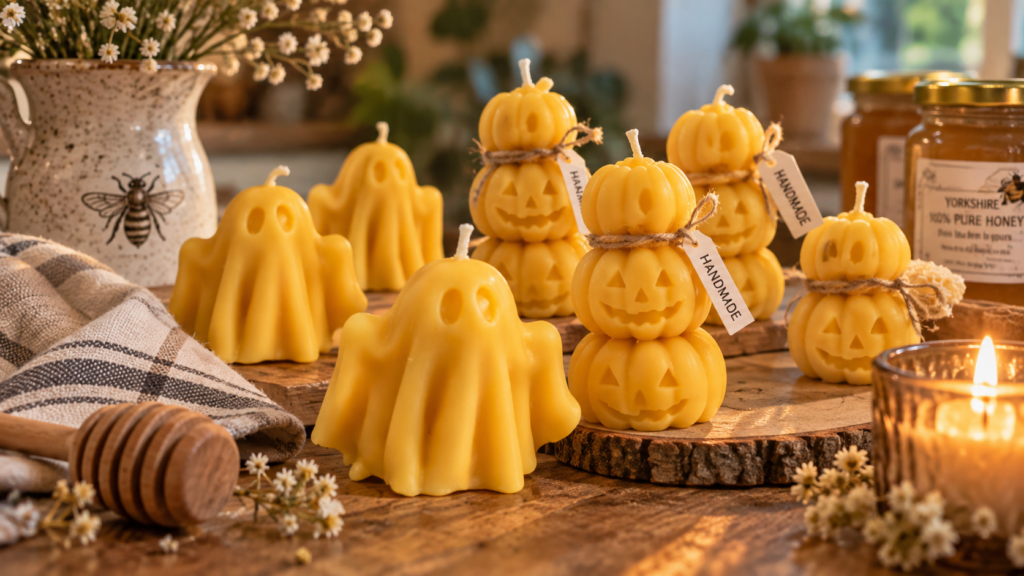
Once the honey has drained away, wax cappings can be cleaned and rendered. That wax can then be used for candle making and other beeswax products.
Cappings wax is often particularly attractive because it tends to be relatively clean, fresh wax.
That means one harvest can provide more than honey.
The bees have created wax, and we can make use of it rather than throwing it away.
This fits naturally with the way we like to work at Barbu’s Apiary: respect what the bees produce and waste as little as possible.
Why are cappings seasonal?
You only get cappings when you are uncapping honey.
That means they appear around extraction time rather than being a constant, year-round product.
The quantity also depends on the harvest. Some years or parts of the season may produce more surplus honey than others.
Weather matters. Forage matters. Colony strength matters.
If the bees need their stores, those stores belong to the bees.
We only harvest surplus honey when it is appropriate to do so.
So when fresh cappings are available, they are very much a seasonal treat.
Why do they look different from batch to batch?
Natural beeswax varies in colour.
Some cappings are almost white. Others are cream, pale yellow or deeper gold. The honey attached to them can also vary from very light to dark amber.
None of this worries us.
We actually like seeing the differences.
A perfectly identical product would probably tell us that too much effort had gone into making nature look standard.
Our bees do not work that way.
Cappings and the extraction process
Honey extraction is one of the busiest and most satisfying parts of the beekeeping year.
Frames come in from the hives, but that does not mean the job is finished.
The cappings have to be removed carefully. The honey must be extracted. Equipment needs cleaning. The honey needs time to settle before it is bottled.
And through all of that, the smell in the room is extraordinary.
Warm honey and beeswax have a scent that is difficult to describe properly if you have never experienced it.
Fresh cappings carry that smell beautifully.
A reminder that honey does not begin in a jar
One reason we like talking about cappings is that they show people another part of the process.
Honey does not appear as a golden liquid in a bottle.
Before that, it was nectar collected flower by flower. It was carried back to the hive, processed by the bees, stored in wax cells and sealed under cappings.
The jar is simply the final stage.
Understanding the steps before it gives you a much greater appreciation for the product.
Natural, irregular and completely connected to the hive
Cappings will never be the neatest product on the table.
That is exactly why we like them.
They are torn and irregular. They can be sticky. Pieces are different sizes. Some carry more honey than others.
They look like they came straight from the honey room because they did.
For people who love natural food and want to experience something a little closer to the hive, they are worth trying.
Our approach at Barbu’s Apiary
We want to share more than jars of honey.
Part of the joy of keeping bees is discovering all the different things a healthy colony creates: honey, wax, comb, cappings and eventually the products we can make from those materials.
Cappings are a perfect example of something that could easily be overlooked.
To us, they represent the moment a frame of sealed honey becomes part of the harvest.
They are a small, sticky piece of the story.
If you would like to try honey cappings, contact Barbu’s Apiary and ask about current availability. They are seasonal and quantities can be limited, so joining our waiting list is the best way to hear when we have some ready.
Why beekeepers get excited about fresh cappings
There is a particular moment during extraction when the first cappings come away from a heavy frame and the honey starts to shine underneath. It is one of those jobs that looks messy from the outside but feels incredibly satisfying when you have spent months caring for the colony.
Fresh cappings are part of that moment. They are warm from the room, sticky with honey and still carry the smell of the hive.
For us, selling a small amount when available is a way of sharing a piece of extraction day with people who would never normally see it.
Using every part with respect
The more time you spend keeping bees, the more difficult it becomes to look at good wax as something disposable.
The colony has invested energy in producing it. That encourages us to think carefully about how it can be reused.
After the honey is enjoyed, suitable cappings wax can be cleaned and rendered. It may later become a candle or another beeswax item.
So a piece of wax can begin as part of the hive, seal a cell of honey, be removed during extraction and then become something completely different.
A good product for curious honey lovers
Cappings are probably not the first hive product most people buy. That is exactly what makes them interesting.
If you already enjoy local honey and honeycomb, cappings are a chance to try something less familiar and much closer to the actual harvesting process.