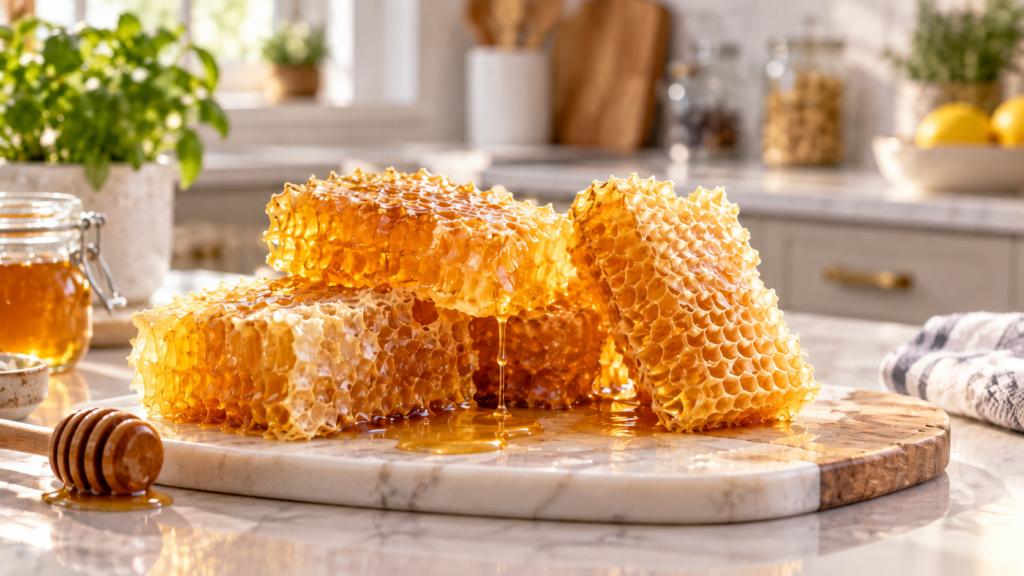
Most people know honey as something that comes in a jar. Honeycomb is different. It is honey exactly where the bees made and stored it: inside delicate cells of natural beeswax.
There is something wonderfully simple about eating honeycomb. You cut a piece, bite into it and get the honey and wax together. There is no need to imagine what the hive looked like or how the honey was stored because the structure is still right there in front of you.
For us at Barbu’s Apiary, that is part of what makes honeycomb special.
Built by the bees
Honeycomb begins with beeswax.
Worker bees produce wax from glands on the underside of their bodies. They manipulate the tiny wax scales and build them into the familiar six-sided cells we associate with a beehive.
Those cells are incredibly useful. Bees use them for raising brood and storing food.
When a comb is being used for honey, foraging bees bring nectar back to the hive. The nectar is passed between bees and deposited into cells. The colony then reduces its water content until it reaches the right consistency for storage.
Once the honey is ready, the bees seal the cell with a thin cap of wax.
That capped comb is the bees’ natural pantry.
Why does honeycomb look so perfect?
The hexagonal pattern is one of the most recognisable structures in nature.
Each cell sits tightly beside the next, creating a strong and efficient pattern. To us it looks almost engineered. To the bees, it is simply the structure they have evolved to build.
The wax can range in colour from very pale cream through to yellow and deeper shades depending on the age of the comb and what has been stored in it.
Honeycomb sold for eating is usually attractive, clean comb filled with honey.
What does honeycomb taste like?
The first thing you notice is the texture.
You get the sweetness and flavour of the honey, but you also get the soft chew of the wax. Fresh comb can feel almost like a natural sweet, except the flavour is coming directly from the honey stored inside it.
And just like our jarred honey, the flavour can change from one harvest to another.
The bees do not visit one identical crop every day of the year. They work whatever flowers are available within flying distance of the hive. That means the nectar coming into the colony changes with the season.
One piece of comb may taste light and floral. Another may be richer or more intense.
We like that variation. It is evidence that the product came from real colonies in a real landscape.
Can you eat the wax?
Yes. Beeswax in honeycomb is edible.
Many people chew the wax after the honey has been released in their mouth. Some swallow it, while others prefer to chew it for a while and then discard the remaining wax.
There is no single “correct” way to eat it.
If you have never tried honeycomb before, start with a small piece. Let the honey release slowly and see what you think of the texture.
Honeycomb and cheese
One of our favourite ways to serve honeycomb is on a cheese board.
The sweetness works particularly well with cheeses that have a salty, creamy or strong flavour. Rather than pouring honey over everything, you can place small pieces of comb beside the cheese and allow people to take as much as they want.
It also looks beautiful on the table.
There is a rustic quality to honeycomb that you simply cannot recreate by squeezing honey from a plastic bottle. It looks like it belongs to the hive because it does.
On toast, yoghurt and desserts
Honeycomb also works well with simple foods.
Try a piece on warm toast and let the honey soften slightly. Add it to Greek yoghurt with fruit. Place a small piece on porridge or use it as a topping for desserts.
You do not need to do anything complicated with it.
In fact, the best uses are often the simplest because you want to taste the honey itself.
Why is honeycomb more seasonal?
Producing honeycomb for eating requires the right colony conditions.
The bees need to be strong enough to draw comb and fill it with honey. There needs to be enough nectar coming into the hive and the weather needs to cooperate.
That means honeycomb is not necessarily available all year.
This seasonality is part of the reality of small-scale beekeeping. We would rather explain that clearly than pretend every hive product should be endlessly available on demand.
When the bees produce good comb and we have some available, it is a lovely product to offer. When they do not, we wait.
Why some comb is lighter than others
People sometimes assume honeycomb should always look identical.
It does not.
Very fresh wax can be almost white. As bees use comb, it may become more yellow or golden. Honey colour also varies depending on the nectar source.
That means one section of comb can look quite different from another while still being perfectly natural.
The supermarket has trained many of us to expect food to look exactly the same every time. Beekeeping quickly breaks that habit.
Nature does not use brand guidelines.
How should honeycomb be stored?
Keep honeycomb sealed and protected from moisture and strong odours.
Honey naturally stores well, but the wax can absorb smells from its surroundings. A sealed container helps protect the flavour.
Avoid leaving it somewhere very warm because the wax can soften.
If your honey begins to crystallise inside the comb, that is not necessarily a problem. Crystallisation is a natural process and some honeys do it faster than others.
The texture will simply change.
Is honeycomb healthier than jarred honey?
We prefer not to make exaggerated health claims about any food.
Honeycomb is a natural hive product containing honey and beeswax. The biggest difference is not that it is a magical health product. The difference is the form in which you are eating it.
The honey has stayed inside the comb built by the bees, and you are eating the wax structure with it.
For many people, the appeal is about flavour, texture, provenance and the experience of eating honey in one of its most natural forms.
A product that connects you to the hive
Honeycomb makes the work of the colony visible.
When you look at a jar of honey, you see the finished liquid. When you look at a piece of comb, you can see thousands of individual cells the bees built and filled.
It reminds you how much work happens before any honey ever reaches a kitchen table.
A single worker bee contributes only a small amount over her lifetime, but thousands of bees working together create the stores that support the colony and, when conditions allow, provide a surplus we can harvest.
That perspective changes how you look at honey.
Why we love offering honeycomb
At Barbu’s Apiary, we are not trying to turn the hive into a factory.
We want people to enjoy products that reflect what the bees naturally produce.
Honeycomb is a perfect example. It is beautiful without needing decoration. It has texture without needing anything added. It changes with the season because the forage changes.
It is honey with its original packaging still attached — packaging made by the bees themselves.
If you have only ever eaten honey from a jar, honeycomb is worth trying at least once.
And if you discover you love it, you will understand why people get excited when the next batch becomes available.
Contact Barbu’s Apiary to ask about current honeycomb availability. Because it is seasonal, quantities may be limited and may change throughout the year.
Why children and first-time tasters often find it fascinating
Honeycomb is also one of the easiest hive products to use when explaining bees to people who have never looked inside a colony. A jar of honey is familiar. A piece of comb immediately raises questions.
People can see the repeating cells, the thin wax walls and the honey held inside. Children in particular often understand the connection much more quickly when they can see the structure the bees actually built.
That makes honeycomb more than a food product. It can be a simple way of starting a conversation about pollination, colony life and the amount of work involved in producing honey.
Cutting and serving honeycomb
Use a clean, sharp knife and cut only what you need. Because the comb is delicate, pressing too hard can squeeze honey from the cells.
For a cheese board, small bite-sized pieces work well. For toast or yoghurt, a slightly larger piece can be broken up with a spoon.
Do not worry if the edges look uneven. Honeycomb is not supposed to look like a factory-cut sweet. The irregularity is part of its charm.
A different way to value honey
Honeycomb also changes the way you think about price and quantity. When you see the wax structure still surrounding the honey, it becomes obvious that the bees created far more than the liquid itself.
They produced the wax, built the cells, gathered the nectar, processed it and sealed it.
That is why we prefer to treat honeycomb as a special seasonal product rather than something that should be available endlessly.