Open a jar of supermarket honey today, then buy the same jar again six months from now, and chances are it will look, taste and feel almost exactly the same.
That consistency is what supermarkets are built around. People expect the same product every time.
Our honey is a little different.
One jar might be slightly darker than the last. Another batch might have a stronger floral flavour. Sometimes the texture can change. Even the aroma when you first open the lid can be different.
And we actually love that.
Because our honey comes from real bees, living in real hives, flying around a real landscape where the weather, flowers and seasons are constantly changing.
We are not trying to make every jar identical.
We are bottling what the bees give us.
And for us, that is part of what makes proper local honey so special.
Our honey begins with the bees
When people see a jar of honey on a shelf, it is easy to forget where it actually came from.
There is a huge amount of activity behind that little jar.
Thousands of bees leave the hive looking for nectar. They fly from flower to flower, collecting what is available around them before returning to the colony.
They do not have a recipe.
We cannot tell them, “Today, only visit these flowers.”
They go where the food is.
One week there might be lots of one particular plant flowering nearby. A few weeks later, something completely different may be producing nectar.
That means the honey naturally reflects what is happening around the hives.
And that is one of the things we find fascinating about beekeeping.
You can look at a jar of honey and sometimes see the season inside it.
Every batch tells us something
One of the first things we notice when honey is collected is the colour.
People often imagine honey as one particular golden shade.
But natural honey can vary considerably.
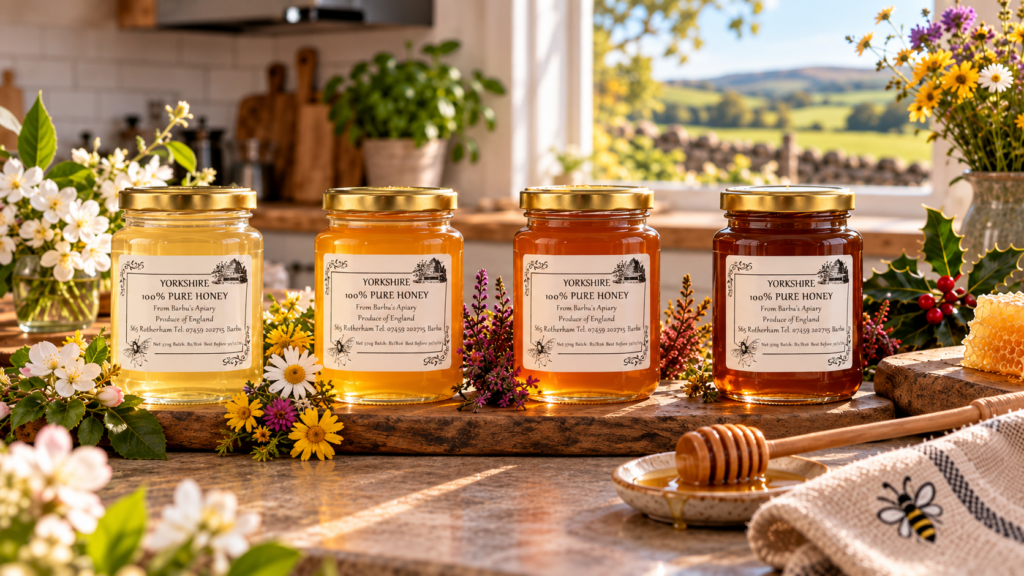
Some batches can be beautifully pale and golden. Others can be deeper, warmer and darker.
Neither is better simply because of the colour.
They are just different.
We also notice differences in flavour.
Sometimes the honey can taste light and floral. Another batch might feel richer or have a stronger flavour that stays in your mouth a little longer.
The bees decide that for us.
Or, more accurately, the landscape does.
The flowers available to the bees influence the nectar they collect, and that becomes part of the character of the finished honey.
For us, opening a new batch is genuinely exciting.
We know it is honey from our bees, but we still get that little moment where we taste it and think:
“Okay. What have they made this time?”
That is difficult to recreate in something designed to taste exactly the same year after year.
We don’t want to remove its personality
There is nothing strange about supermarkets wanting consistency.
If you buy a particular cereal, chocolate bar or bottle of sauce, you expect it to taste the same every time.
Large-scale food production is designed around that idea.
But when you are producing honey on a much smaller scale, we think there is something lovely about allowing the natural differences to remain.
If this year’s honey tastes slightly different from last year’s honey, that doesn’t worry us.
It interests us.
Because we know there is a reason.
Maybe the spring was particularly warm.
Maybe one type of flower appeared in greater numbers.
Maybe the bees found a particularly good source of nectar that year.
Bees are incredibly good at finding what they need, and you quickly learn as a beekeeper that you are working alongside nature rather than controlling it.
That is an important difference.
We can care for the colonies.
We can inspect the hives.
We can make sure the bees have what they need.
But ultimately, they are the ones making the honey.
Texture is part of real honey too
Another thing that occasionally surprises people is that natural honey does not always stay perfectly runny forever.
Over time, honey can begin to crystallise.
That can make it thicker, grainier or eventually much firmer.
Some people see this happen and immediately wonder if something has gone wrong with the honey.
It hasn’t.
Crystallisation is a natural process.
Different honey can crystallise at different speeds depending on its natural composition and how it has been stored.
We actually think this is another nice reminder that honey is a natural food.
It changes.
Personally, we enjoy seeing those differences.
Some people love honey when it is runny and easy to drizzle over yoghurt or porridge.
Others prefer it when it becomes a little thicker and can be spread onto toast.
And if your honey does crystallise, it doesn’t suddenly mean it has become bad honey.
It has simply changed texture.
The smell when you open the jar
Taste usually gets most of the attention, but we think the smell of honey is underrated.
Open a jar and have a proper smell before putting it on anything.
There is a softness to it.
Depending on the batch, you may notice floral notes or something slightly richer and warmer.
It is one of those small things that reminds us why we enjoy producing our own honey.
When you have cared for the bees, opened the hives, watched the colonies grow and finally reached the point where honey can be collected, that smell means something.
There is a story behind it.
We know exactly where those bees live.
We know how much work is happening inside those hives every single day.
So when we put that honey into a jar, it never really feels like we are simply filling another product.
It feels like the end of a very long journey.
A jar doesn’t begin in our kitchen
It begins outside.
It begins with flowers opening.
It begins with the weather warming up.
It begins when the bees start leaving the hive in greater numbers.
Then thousands of tiny journeys take place that we will never see.
A bee might travel out, collect nectar and return.
Then another does the same.
Then another.
Again and again.
Eventually, that activity becomes the honey you spoon onto your breakfast.
When you stop and think about it, it is quite extraordinary.
And perhaps because we are so close to that process, we don’t want to strip away everything that makes each batch individual.
The small changes in colour, taste and texture are part of the journey.
There is no “perfect” colour for honey
We sometimes judge food with our eyes before we’ve even tasted it.
If something looks slightly different from what we expect, our first reaction can be to think something is wrong.
Honey is a good example.
People can become used to seeing a very specific golden colour on supermarket shelves.
But natural honey comes in many shades.
Pale honey isn’t automatically better.
Dark honey isn’t automatically stronger.
And two jars produced at different times can look noticeably different while both being wonderful.
Instead of seeing that variation as a problem, we think it should be celebrated.
It means the honey still has a connection with where it came from.
We eat the same honey we sell
Perhaps one of the simplest things we can say about our honey is that this is the honey we have in our own home.
It isn’t a separate product created purely for customers.
We use it ourselves.
We put it on food.
We taste new batches.
We notice when the flavour changes.
And when we find ourselves going back to the jar for another spoonful, that’s normally a pretty good sign.
There is something satisfying about eating something that has come from bees you have personally looked after.
And when somebody buys a jar from us, we want them to feel a little bit of that connection too.
You are not simply buying something sweet.
You are buying honey that has come from a particular group of hives, during a particular season, from bees that have been exploring the landscape around them.
There will never be another season exactly like it.
Sometimes different is better
Modern food production has trained us to expect perfection.
Every biscuit should look identical.
Every tomato should be roughly the same size.
Every jar should taste exactly like the one before it.
But nature doesn’t really work like that.
Apples grow in different shapes.
Vegetables vary in size.
Flowers don’t bloom according to a manufacturing schedule.
And bees certainly don’t produce honey according to one.
That unpredictability is one of the reasons Claudiu has remained so passionate about beekeeping since he first started keeping bees in Romania in 2006.
Even after years of experience, the bees can still surprise you.
You are always watching.
Always learning.
Always noticing something slightly different.
And the honey is part of that.
So what should you expect from a jar of our honey?
Expect something made by bees rather than designed by a factory.
Expect the colour to occasionally vary.
Expect one batch to taste slightly different from another.
Expect the texture to change naturally over time.
And most importantly, expect something we are genuinely proud to put our name on.
Barbu’s Apiary isn’t about trying to create millions of identical jars.
It is about sharing something we love.
The bees do most of the extraordinary work.
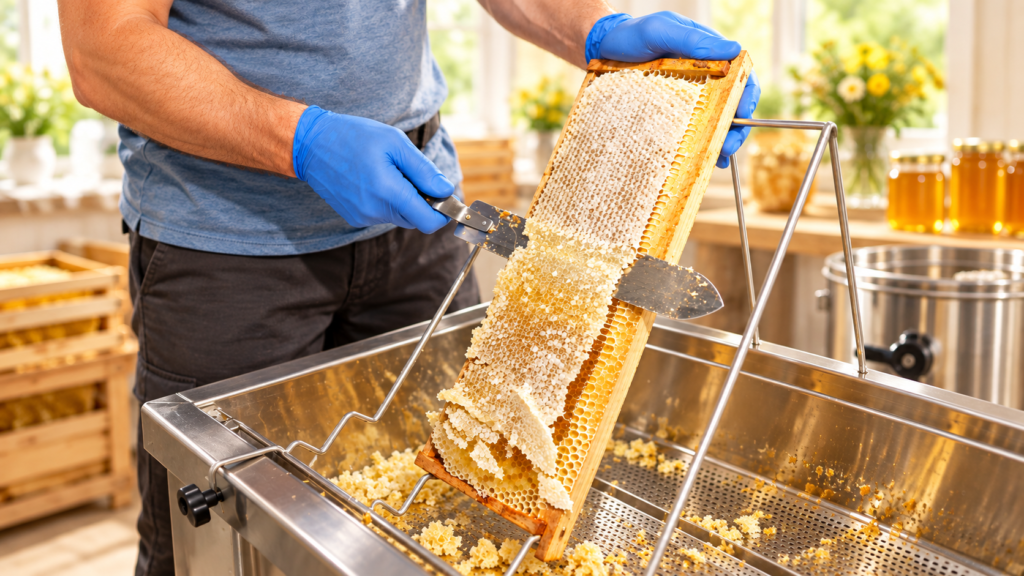
Our job is to look after them, respect what they produce and get that honey from the hive into the jar.
After that, there is really only one thing left to do.
Open the lid.
Get a spoon.
And taste what the bees have been up to.